Washable Travel Neck Pillow Covers: How to Check Care, Fit and Durability
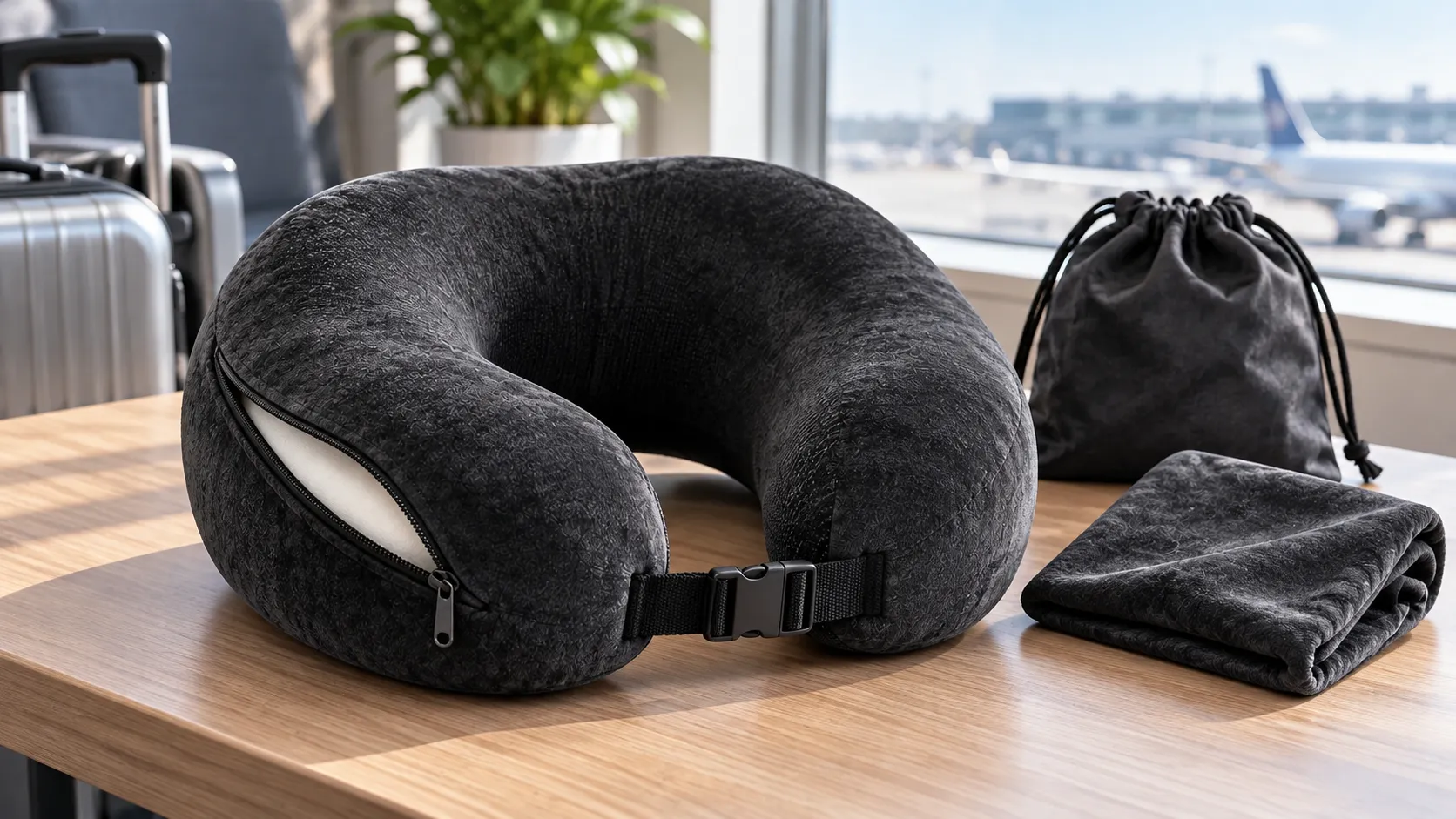
A travel neck pillow with a washable cover is useful only if the specific cover can undergo the stated cleaning process and still fit the foam core afterward. A zipper proves that a cover may be removable; it does not establish that the fabric, seams, decorative finish and zipper will withstand machine washing. Nor does a washable cover mean the memory foam filling can be washed in the same way.
For travel accessory brands and OEM buyers, “washable” should be treated as a verifiable product specification, not a general benefit attached to all memory foam pillows. The purchase decision needs a defined care method, an approved sample and evidence that the finished cover remains functional after that treatment.
Removable, Washable and Machine Washable Are Different Claims
Three phrases often appear together in product listings, but they answer different questions.
Removable cover describes construction. It tells the buyer that the outer textile layer can be taken off using the intended opening, such as a zipper, and put back on the core.
Washable cover describes an allowed care operation. The supplier needs to specify what kind of washing is permitted and any relevant drying restrictions. It should not be used as a vague substitute for instructions.
Machine-washable cover is more specific still. It implies an identified machine-washing procedure is suitable for that cover, including the complete textile assembly rather than just a loose fabric swatch. Machine washing can affect seams, zippers, logos, prints and dimensional fit as well as the fabric itself.
| Product statement | What it establishes | What it does not establish |
|---|---|---|
| Removable cover | The cover is designed to be removed and reinstalled | Permission to machine wash or tumble dry |
| Washable cover | A defined washing treatment should be documented | That every wash temperature and detergent is suitable |
| Machine-washable cover | The specified machine-washing method is supported | That the foam core, accessories or all alternative covers share the same care conditions |
| Replaceable cover | A compatible replacement can be specified or sourced if offered | That replacements are always stocked or interchangeable between models |
The material inside the pillow is a separate component. Memory foam commonly has different care limitations from woven or knitted cover fabrics. A supplier should not describe an entire memory foam travel pillow as machine washable unless the claim genuinely applies to the complete product and has supporting evidence.
ENNASI lists a black jacquard-velvet U-shaped travel pillow in its product records. Its published name identifies a memory foam pillow and a jacquard-velvet cover. It does not, by itself, establish that this particular cover is removable or machine washable; those are separate details for the exact version.
Why Cover Material Alone Cannot Predict Washability
Fabric composition matters, but so does the complete cover construction. Two covers described as “velvet” or “mesh” can have different fibres, finishes, backing materials or stitching. They can behave differently after the same cleaning process.
For an OEM sample, review the fabric and every part that goes through washing:
- Outer fabric and lining. Identify the real fibre composition and any laminate or backing rather than relying on a marketing name.
- Seams and thread. A seam that looks neat when new still needs to remain sound after the intended care process.
- Zipper or opening. The closure must continue to operate correctly after the permitted treatment.
- Prints, embroidery and applied logos. Decoration may have different care limitations from the surrounding fabric.
- Trims and attachments. Cords, labels and other components should be considered in the test unit when they remain attached during washing.
A soft cover is not necessarily a durable cover; a thick fabric is not automatically more colourfast; and an apparently strong zipper may still be unsuitable for a particular construction. These characteristics require observation or testing under defined conditions.
The finished-cover test should be conducted on the version the buyer intends to purchase. Changing the fabric, backing, dye, zipper or logo application after testing can alter the result and may justify another assessment.
How to Verify a Travel Pillow Cover’s Washing Performance
A defensible washability claim starts with a defined care programme. It is not enough to say that samples were “washed and looked fine.” The record should identify the test unit, washing and drying procedure, number of cycles and acceptance requirements.
For textile testing, ISO 6330:2021 describes domestic washing and drying procedures. It offers a controlled way to specify the treatment applied during an evaluation. The procedure is a method, not a certificate that a particular ENNASI pillow has passed.
The buyer should select a washing and drying route appropriate to the intended claim and market, then examine several different outcomes.
Check Size and Shape After Washing
A cover can look clean while becoming too small to fit the foam properly. Compare the measured dimensions before and after the selected treatment. ISO 5077:2007 is a published method for determining textile dimensional change after specified washing and drying. The relevant procedure and measurement points must be recorded.
For clarity, consider a purely illustrative measurement: if a cover dimension is 250 mm before washing and 242 mm afterward, the change is:
((242 − 250) / 250) × 100 = −3.2%.
That is a 3.2% decrease in the selected dimension, not proof of acceptable performance. Whether it is acceptable depends on the agreed tolerance, other dimensions and how the cover fits its actual foam core. This example is not ENNASI test data, a typical shrinkage rate or a recommended tolerance.
Evaluate Colour and Visible Finish
Laundry may change colour or surface appearance. AATCC TM61-2013e(2020)e2 describes an accelerated test for colourfastness to laundering. It is relevant when a brand needs to compare colour change and staining under specified test conditions. An accelerated test result should not be translated directly into a guaranteed number of years of consumer use.
The buyer may also need appearance checks that address pilling, fabric distortion, surface pile, print cracking or other effects relevant to the chosen finish. The test package should match the claim being made; one colourfastness result alone does not prove every aspect of wash durability.
Refit the Cover to the Actual Foam Core
Measure the cover, then put it back on the specified core after the permitted drying process. The assembled product should be inspected for a distorted outline, excessive tension, slack fabric, a hard-to-close zipper or seams that are pulled out of position. A result for a flat fabric specimen does not replace this complete-product check.
A practical sample record might use the following columns:
| Test stage | Evidence to record | Main decision |
|---|---|---|
| Before washing | Cover version, textile composition, photographs and marked dimensions | Is the initial sample clearly identified? |
| Care treatment | Washing method, drying method and cycles | Does the test match the proposed care claim? |
| After washing | Dimensions, colour and fabric appearance | Are results within buyer-approved criteria? |
| Closure check | Zipper operation, seam condition and trim condition | Is the cover still functional? |
| Reassembly | Fit on the designated core and finished-pillow appearance | Does the complete pillow remain acceptable? |
| Label approval | Care instructions and packaging wording | Do instructions match the supported treatment? |
No universal shrinkage percentage, colour grade or wash-cycle count should be assigned without a product specification and acceptance agreement. Test reports need to identify the version actually evaluated.
Why a Washed Cover Can Fail Even When the Fabric Looks Good
A travel pillow is a shaped object. Its textile cover follows the curves of the foam, including the inner opening, side wings and often a narrow front section. Small dimensional changes can therefore be especially visible at the curved seams or zipper line.
A cover that becomes tighter may compress the core differently or distort the familiar U shape. A cover that becomes looser may wrinkle or migrate during use. Misalignment around the zipper can make reinstallation difficult, even if the zipper still opens and closes on a flat table.
This is why the sample inspection should include the complete pillow, not just the washed textile. The foam used for the fit check should be the intended model, not an approximate substitute. If the cover comes in several fabric variants, the buyer may need separate evidence for each materially different construction.
The assembly step can also uncover a design problem. An opening that is too narrow can make removing and fitting the cover difficult even before washing. A design improvement may require a different zipper position, seam allowance or opening arrangement, rather than simply choosing a different textile.
What Should the Care Label Actually Say?
Care information is a practical instruction to the end user. ISO 3758:2023 establishes a system of textile-care symbols covering washing, bleaching, drying, ironing and professional care. It provides a framework for communicating permitted treatments; it does not establish the treatment that a specific travel-pillow cover can withstand.
The approved label should distinguish the removable textile cover from the foam core. It should make clear which component the instructions refer to, and it should avoid implying that the whole pillow is machine washable when only the cover has been assessed.
For a private-label product, compare the packaging claim, online listing and sewn-in label. These should not contradict each other. If a product page says “machine washable” while the supplied care instructions specify a different method, the discrepancy needs to be resolved before launch.
Labelling requirements also depend on the destination market and product classification. An international symbol standard does not automatically resolve every local legal requirement. The importing brand should check the applicable market requirements and use the validated care information for the specific SKU.
A Washable Cover Is Not Automatically a Replacement-Cover Programme
A buyer may want to remove a cover for cleaning. Another buyer may want to sell additional covers or supply replacements to customers. These are related but distinct purchasing requirements.
A replacement cover must match the intended foam shape, zipper or closure arrangement, seam position and visible finish. A similar U-shaped silhouette is not enough to establish compatibility. Even when the pattern has not changed, a different fabric or production batch can affect the finished appearance.
Before treating replacement covers as a separate line item, determine whether the supplier actually offers them for that product and what version identifier will be used. Ask whether the order includes one cover per pillow, an additional spare cover, or independently packaged replacement units. These choices affect packaging and inventory, but they should not be described as available ENNASI services for every SKU without order-specific confirmation.
For distributors selling several travel-pillow shapes, the specification should prevent covers for different models from being confused. Colour names alone are poor part identifiers; the actual pattern and core dimensions are more reliable.
How to Approve a Washable-Cover Travel Pillow for Wholesale
A careful purchasing brief connects product construction, care claims and delivery requirements in one record. It should identify the specific travel-pillow model, foam core, cover material and all trims. Include the approved method for removing and refitting the cover, the washing and drying treatment under evaluation, the test results and the final care-label wording.
The approval process does not need to be complicated, but it should answer three questions: What exactly was tested? What did the test show? Is the product being sold the same configuration?
ENNASI’s travel neck pillow range provides examples of U-shaped memory foam products and travel accessories. The company also describes product sampling and cover-fit checks as part of its quality workflow. These are useful starting points for a custom project, not evidence that every listed cover is approved for a particular washing programme.
When requesting a quote, contact ENNASI with the required pillow shape, cover fabric, removal design, proposed washing claim and destination market. Request the matching care instructions and sample evidence before approving “machine washable” or another specific claim for the product listing.
A washable-cover travel pillow is not defined by a zipper alone. It needs a cover that can be cared for as described, reassembled without losing its intended fit and supplied consistently against an agreed specification.