Travel Neck Pillows for Car Passengers: Fit, Support and Safety Considerations
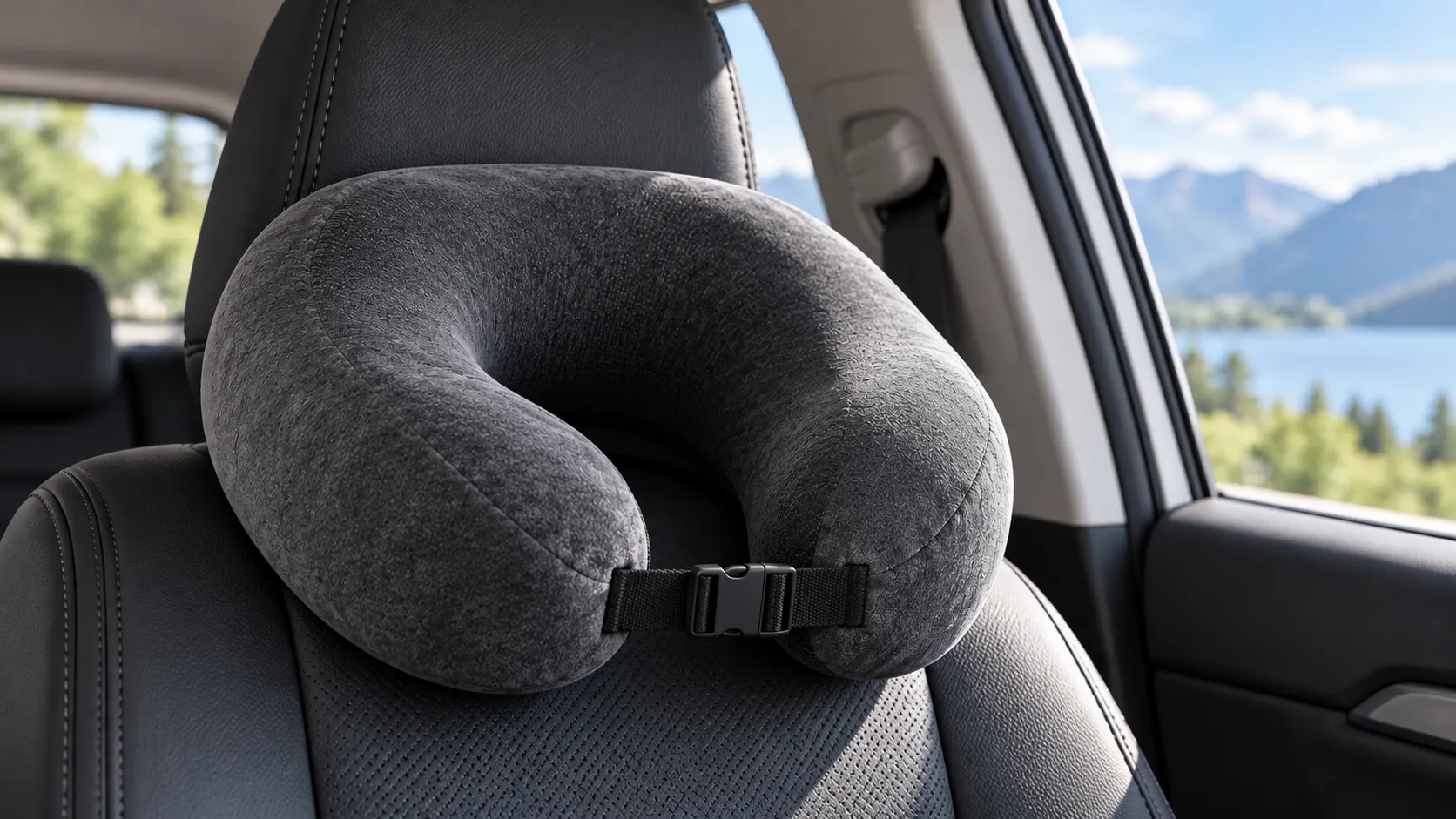
A travel neck pillow for car use should fit the passenger’s normal seating position without pushing the head away from the vehicle’s original head restraint or interfering with the seat belt. Shape and softness matter, but they come after seat compatibility. A comfortable pillow in an airline seat may feel awkward against a car seat because the backrest contour, head restraint and available space are different.
For buyers developing a car-travel accessory line, the decision is therefore more specific than choosing a U-shaped memory foam pillow. The proposed design needs to suit the intended passenger, seat and use case. A portable pillow worn around the neck is also a different product from a cushion attached to a seat. Neither should be presented as an automotive safety restraint or as a replacement for the vehicle’s factory head restraint.
Why Does a Car Seat Change How a Travel Neck Pillow Fits?
A passenger seat is designed around a particular combination of backrest, head restraint, seat-belt geometry and occupant position. Seat contours differ across vehicles. A pillow with a thick rear section may change where the back of the head rests; a tall side section may contact the jaw or ear sooner than intended. These effects can be apparent even when two pillows use the same memory foam material.
Consider the difference between a pillow resting loosely around the neck and a cushion positioned against the seat. The wearable pillow moves with the passenger. The seat-attached cushion is positioned relative to the seat, so its height and contact area depend on the attachment location. Neither arrangement is automatically suitable for every seat.
The comparison should start with the actual product shape rather than a generic claim of “ergonomic support.”
| Product format | Main fit variables | What a buyer should examine |
|---|---|---|
| Wearable U-shaped neck pillow | Neck opening, side-wing height, rear thickness and closure | Whether the wearer can maintain a natural seated posture and use the vehicle equipment normally |
| Adjustable wearable pillow | The variables above, plus closure type and usable adjustment range | Whether adjustment changes the contact position without creating unwanted pressure |
| Seat-attached neck or headrest cushion | Cushion depth, attachment height and the seat’s head-restraint shape | Whether the attachment stays correctly positioned and does not obstruct vehicle systems |
ENNASI lists an adjustable memory foam travel neck pillow for car use in its travel-pillow catalogue. That product title establishes the intended car-travel application and an adjustable design claim; it does not establish the adjustment range, a particular vehicle fit or any crash-safety result. Those details must be evaluated on the exact sample.
A Comfort Pillow Is Not a Vehicle Head Restraint
This distinction deserves attention in any car travel neck pillow specification.
The original head restraint is part of the vehicle’s occupant-protection design. Its position relative to the head matters, particularly in rear impacts. The Insurance Institute for Highway Safety (IIHS) evaluates head-restraint geometry using height and the distance behind the occupant’s head, often called backset. A travel pillow has a different purpose: providing optional comfort in ordinary use. It is not a substitute for that restraint.
An accessory should therefore be rejected for a particular seat if it prevents the occupant from maintaining the seating position required by the vehicle manufacturer, obstructs the safety belt, restricts normal seat functions or requires changing the original head restraint to an unsuitable position. The fact that a pillow feels soft or supportive does not settle those questions.
Do not treat a pillow as an injury-prevention device. A claim about protecting against whiplash, preventing neck injury or improving crash performance requires product-specific evidence. A comfort-product description cannot supply that proof.
This article concerns adult passengers. Child restraints have separate requirements, and unapproved cushions or pillows should not be added to a child restraint. The same article should not be used to recommend sleeping while driving or an accessory that interferes with a driver’s normal control, posture or view.
Which Dimensions Matter More Than the Overall Size?
Overall length and width are useful for packing and cartons, but they do not fully describe how a pillow fits a neck or a seat. For sample review, four measurements are often more informative:
Rear thickness. This is the depth of the part behind the neck or head. A thick rear section may fill an unwanted gap, but it can also push the head forward when the seat already provides support. The effect has to be observed in the intended seat.
Side-wing height. Higher wings change where the pillow contacts the sides of the neck and head. Compare their position with the user’s natural resting posture rather than assuming that more height is always better.
Internal opening. Two U-shaped pillows with the same outside width can have very different openings. The inner contour and any front closure influence the fit.
Adjustment range and closure. If a model is described as adjustable, identify what changes: the front opening, strap length, circumference or another component. An adjustable label without a diagram does not specify a measurable range.
A useful dimension sheet labels each measurement on a front, side or section view. It should distinguish the relaxed shape from any compressed shape if the supplier uses both. For OEM development, compare samples in the same seat and record the model, key dimensions and fit comments. A photograph alone cannot replace that comparison.
Wearable Pillow or Seat-Attached Cushion?
These categories may serve related retail channels, but they have different design and installation questions.
A wearable U-shaped pillow can be carried between vehicles and other travel settings. Its shape, weight, cover and closure influence portability and contact comfort. A seat-attached cushion depends more heavily on the seat geometry and its fixing method. It may use an elastic strap or another attachment arrangement, but such features must be verified on the selected product.
ENNASI’s headrest-pillow collection includes vehicle-oriented comfort cushions alongside its travel neck pillow range. They should be compared as separate product formats, rather than assumed to offer identical attachment or fit characteristics.
For a seat-attached product, check where the strap or attachment runs, whether it stays in the intended location during normal seat adjustments and whether any seat feature is obstructed. Avoid placing accessories over controls, restraint hardware or other components where the vehicle manufacturer prohibits them. For a wearable pillow, check whether it interferes with the shoulder belt or causes the occupant to adopt a strained position.
Neither a stronger strap nor a firmer foam core demonstrates safer performance. The correct question is whether the finished accessory is appropriate for the specific seat and intended ordinary-use activity.
Material, Cover and Packing: What Matters for Car Travel?
A memory foam label identifies a broad filling category. It does not specify density, firmness, rebound time or how the assembled pillow will feel. The contour, cover tension and actual foam formulation contribute to the finished product.
For car-travel accessories, evaluate the cover material as carefully as the filling. Contact comfort, texture, lint retention and routine cleaning requirements can matter to frequent users. A cover described as removable is not necessarily machine washable; the permitted care process must be supported by the particular material and its construction.
Packaging is another separate decision. Compare the product’s packed dimensions, protective bag and whether it is supplied with accessories. If compression packing is proposed, require the documented packing configuration and an assessment of the unpacked sample rather than assuming all memory foams recover in the same way. Do not infer a recovery time from the word “memory foam.”
For wholesale planning, a short product specification is more useful than a long string of marketing descriptors:
| Specification item | Information to retain |
|---|---|
| Shape and intended use | Wearable U-shaped pillow or seat-attached cushion; adult passenger application |
| Dimensions | Outer size, rear thickness, neck opening, side-wing height and actual adjustment range where applicable |
| Core | Actual foam specification and any tested performance claims |
| Cover | Material composition, removal method and verified care instructions |
| Closure or attachment | Component type, position and functional limits |
| Packaging | Individual pack, accessories and carton configuration |
| Samples | Version identifier, target seat conditions and recorded fit findings |
If the product is intended for a private-label program, logo placement and packaging artwork should follow approval of the functional sample. A change to the cover or closure can also change the way the final pillow fits.
How to Evaluate a Car Travel Neck Pillow Sample
A sample that looks good on a white background may perform differently in a vehicle. A controlled, ordinary-use fit review makes the purchasing decision more defensible.
Start with the intended seat and adult passenger population. Check the vehicle manufacturer’s guidance for correct seating and head-restraint adjustment. Then inspect the pillow under normal stationary conditions with the safety belt positioned as required. Do not conduct improvised crash, sudden-braking or road tests to assess a comfort accessory.
The sample review should record the following:
- Seat and head-restraint arrangement: the seat type, its normal adjustment and whether the accessory changes head-restraint contact or positioning.
- Pillow position: whether the product remains where intended without forcing the head forward or sideways.
- Belt and seat functions: whether the belt, adjustment controls or normal seat operation are obstructed.
- Fit across users: whether the opening and side sections accommodate the planned adult user group without undue pressure.
- Attachment and closure: whether the specified mechanism works as designed in ordinary use.
- Care and packing: whether the supplied cover, carrying format and accessories match the sample specification.
Use the same checklist for every candidate. Separate subjective comfort comments from observable dimensions, fit and interference. If a sample fails an essential seat-compatibility requirement, do not score it highly on softness or appearance to compensate.
This process is a product-fit review, not a crash certification, clinical study or endorsement by the vehicle manufacturer.
Turning the Car-Travel Requirement into an OEM Specification
A useful request for quotation says more than “comfortable memory foam car pillow.” It identifies the product format, intended user and key constraints. Include drawings or a sample reference for the desired outline, a list of target dimensions, the cover and closure requirements, accessory details, packaging route and expected order quantity.
If the buyer wants a seat-attached cushion, identify the intended seat type and requested attachment arrangement. If the buyer wants a wearable pillow, provide the proposed opening shape and the range of adjustment expected. Any compatibility claim should be assessed for the exact design and use conditions rather than generalized to every vehicle.
The ENNASI travel pillow catalogue provides product-family examples, while the headrest pillow collection shows a distinct seat-accessory category. These are starting points for narrowing the specification, not guarantees that one SKU suits every installation.
For a project brief, contact ENNASI with the product format, target dimensions, cover requirements, packaging direction and sample-approval criteria. A sound purchasing decision keeps occupant safety requirements separate from the comfort features of the pillow, then evaluates the finished product in the conditions where it will actually be used.